
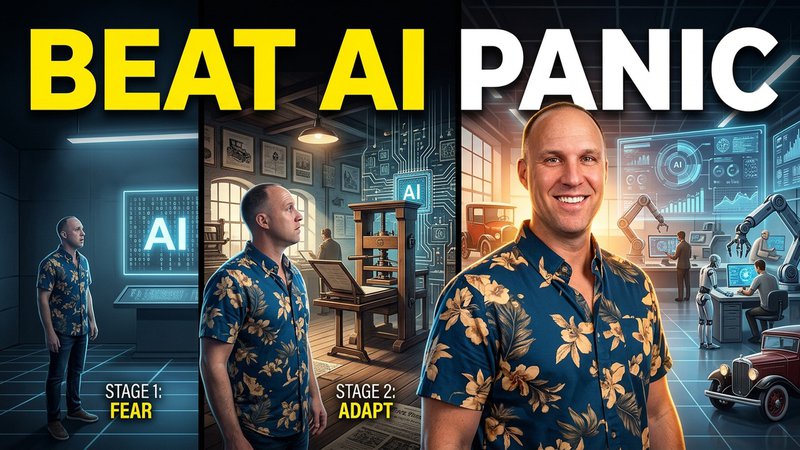
AI: Separating Hype from Reality
Artificial intelligence is everywhere in today’s conversations, hailed by some as society’s next great hope and by others as its doom. But as Tyson Gaylord highlights on the Social Chameleon Show, the real challenge isn’t the technology itself. It’s our ability to move beyond soundbites, make sense of complex change, and decide how to adapt meaningfully. This episode’s deep dive into AI’s history and practical applications offers context, clarity, and actionable wisdom for those ready to engage thoughtfully.
Historical Patterns: New Tech, Old Fears
From the printing press to electricity, every major technology has followed a similar pattern: first comes fear, then awkward regulation, followed by adaptation, and finally, the integration into everyday life until it fades into the background. Tyson walks listeners through a series of vivid examples:
- Printing Press: Intellectual elites of the 15th and 16th centuries warned of “information overload” and the end of memory, only for literacy and ideas to flourish as printing spread.
- Railways and Factories: Nineteenth-century doctors claimed trains could cause brain damage. Laborers panicked about job loss. But new jobs and industries grew alongside the machines.
- Telegraph, Telephone, Electricity: Skeptics dismissed the telephone as a “toy.” Critics feared electric power would kill jobs for lamplighters and messenger boys. Today, those fears seem quaint.
- Computers and the Internet: Mainframes triggered visions of automation-driven unemployment. The rise of personal computers and, later, the internet came with dire predictions, none of which played out as expected.
Throughout these eras, the story is less about the tech and more about our struggle to adapt. As Tyson Gaylord notes, forecasts are nearly always wrong, and opportunities tend to outpace predictions of decline.
Understanding AI, Past the Panic
The same fears and wild hopes now surround AI. The most vocal voices usually have little grasp of what a large language model does. Tyson urges listeners to cut through the extremes:
- Doomsayers predict mass unemployment, runaway superintelligence, and social collapse.
- Boosters promise a cure for every disease, limitless clean energy, and days filled with leisure.
Both sides, he points out, are driven by clicks, funding, and headlines rather than accuracy. The real picture is more nuanced, with change arriving in leaps and new risks, but also with direct, incremental benefits and opportunities.
Essential AI Vocabulary (De-hyped)
To empower informed discussion, Tyson clarifies common AI terms:
- Artificial Intelligence: A broad umbrella covering everything from simple algorithms to advanced neural networks.
- Machine Learning: Systems that find statistical patterns in data, not by following rules but by learning from examples, think Google’s autocomplete.
- Deep Learning: Multi-layered networks inspired by the brain, essential to recognizing traffic lights in CAPTCHAs or classifying images.
- Generative AI: Models that produce text, images, or code, which power modern chatbots and image generators.
- Large Language Models (LLMs): Engines that “predict” the next best word or sentence based on enormous datasets, such as the text that powers smart search and chatbots.
- AI Agents: Software that automates multi-step processes by combining LLMs with planning and memory. Imagine a tireless, highly literal assistant who needs detailed training rather than broad hints.
The Real Opportunities and Risks
Five Common Fears
- Superintelligent Runaway AI: Stories like the “paperclip maximizer” spark worry, but Tyson Gaylord emphasizes these dangers are speculative and based on misunderstood training scenarios, not real-world results.
- Autonomous Weapons: AI can misidentify targets and escalate conflicts. Human oversight is necessary for the foreseeable future.
- Deepfakes and Misinformation: Digital forgeries make it harder to trust media. The solution? Learn to vet information critically and use emerging tools to verify authenticity.
- Cognitive Atrophy: There’s concern about losing critical thinking if we rely too much on AI. Studies suggest AI helps experts but may mislead novices, so judgment matters.
- Labor Displacement: Every new technology threatens jobs, but it also creates new industries, roles, and opportunities we can’t yet imagine.
Five Utopian Promises
- Curing Disease & Longevity: AI is already expediting scientific breakthroughs, especially in healthcare and biology, but transformative change will likely come more slowly and incrementally than the hype suggests.
- Clean Energy Solutions: AI may help optimize and scale new forms of energy, including nuclear and localized power generation, unlocking advances we can’t yet fully foresee.
- Post-Scarcity Economics: Automation might make more goods and services abundant and affordable.
- Personalized Healthcare & Education: Smart devices and educational platforms stand to tailor support and learning to individual needs, closing gaps and leveling the playing field.
- Accelerating Scientific Discovery: AI as a research partner could help crack complex problems faster, from climate modeling to drug development.
Principles for Navigating the AI Era
Tyson breaks down practical frameworks for individuals and leaders looking to thrive in an AI-powered world:
- Focus on Tasks, Not Jobs: AI is best at automating specific, repeatable tasks. High-touch, strategic, emotionally intelligent roles will remain valuable.
- Demand Human Oversight: For now, keep a person “in the loop” for outputs that matter. AI is a tool, not an oracle.
- Resist Binary Thinking: Don’t fall for the “all or nothing” trap. Blend optimism with skepticism—and test, adapt, and design your own approach.
- Delete Dumb Requirements: Automating bad processes just makes nonsense faster. Re-examine workflows before handing anything to AI.
- Invest in Learning: Stay curious. Try new tools, especially those that free you from tasks you dislike or that drain your energy.
Where the Opportunities Are
A standout resource from the episode is Benchmark’s interactive database, which tracks where AI is already making an impact, where adoption is lagging, and where gaps—meaning opportunities—exist across industries, from law to healthcare to engineering. Many fields remain wide open. If you’re willing to experiment, learn, and spot needs, you’ll find places to add value or even invent new careers.
The Breakdown
The hardest part of every technology wave isn’t the tool; it’s our mindset. The fears, excitement, and uncertainties surrounding AI echo every past advance, whether the printing press or the internet. Tyson urges leaders and lifelong learners to breathe, stay pragmatic, and focus on using these new tools intentionally. Adapting isn’t about blindly adopting or rejecting what’s new. It’s about thoughtful experimentation, critical thinking, and building the skills and resilience to grow no matter what gets automated next. As history shows, those who stay ready and creative will have the most to gain.
Enjoy the episode!
YouTube & Show Notes
Available on:Apple Podcasts •Spotify •Overcast •Pocket Casts •Castbox •YouTube Music •Amazon Music •Audible •Substack • Everywhere you canlisten
✨ Legendary Weekly Challenge ✨
This week, your challenge is to pick one annoying or time-consuming task and try out a current AI tool (preferably a paid account for better results). Look for tasks you dislike or find draining, especially those you still have to do because they’re revenue-producing or necessary. See if an AI tool or agent can take those off your plate, so you can focus on work that energizes and excites you. The goal is to free up your time for things you enjoy and are good at, letting AI handle more routine or tedious work.
Did an AI disappoint you last year? Give it another try — these tools are improving fast. Find ways to reclaim your calendar for the stuff that sparks energy.
SELECTED LINKS FROM THE EPISODE
People to Learn From
- Unsupervised Learning
- https://newsletter.danielmiessler.com
- https://www.youtube.com/@unsupervised-learning
- A realistic look through the lens of security and a holistic life use of AI through his development products.
- AI News & Strategy Daily | Nate B Jones https://www.youtube.com/@NateBJones
- Mostly Business Uses and Technical Foundations
- Cal Newport - AI Reality Check (Thursday) https://www.youtube.com/@CalNewportMedia
- His regular podcast focuses on living a well-balanced digital life.
- Greg Isenberg https://www.youtube.com/@GregIsenberg
- Startup, SASS, & Business Uses
- Jack Roberts https://www.youtube.com/@Itssssss_Jack
- General & Business Uses with a strong focus on web design.
- Income stream surfers https://www.youtube.com/@Incomestreamsurfers
- Website and SaaS builds.
- Jake Van Clief https://www.youtube.com/@JEVanClief
- General & Business Uses from a fundamentalist perspective.
- Matt Wolfe https://www.youtube.com/@mreflow
- General news and breakdowns
- Nate Herk | AI Automation https://www.youtube.com/@nateherk
- General & Business Uses
- Riley Brown https://www.youtube.com/@rileybrownai
- General & Business Uses
- Sabrina Ramonov https://www.youtube.com/@sabrina_ramonov
- Social Media Focused
- 9x https://www.youtube.com/@go9x
- General Business Uses
- Ras Mic https://www.youtube.com/@rasmic
- Mostly Development Uses
- Futurepedia https://www.futurepedia.io
- General & Business Uses
- AI for Humans https://www.aiforhumans.show
- General Business Uses
- Better Offline https://www.betteroffline.com
- Might be the most realistic views, definitely on the Doom side. Heavy leaning towards the financial side of the artificial intelligence industry.
Links
- https://the-decoder.com/readers-rate-ai-generated-short-stories-higher-than-human-ones-until-they-learn-a-machine-wrote-them
- Benchmark List
- Track AI progress with the largest database of benchmarks.
- Job Capabilities - I believe this is the most important component of this research project.
- SkillSpector by NVIDIA
- One vulnerability I’m aware of that these skill checkers, at the time of publication, can’t detect is that a URL may point to a legitimate website when installed, but months later the site changes to a malware‑type destination. So please be aware of what you’re installing and who you’re installing it from, and whether those websites need to be in that skill.
Other Resources
- The Black Swan by Nassim Taleb
- Ground News
- Alpha School
- AlphaFold
- Small Data Centers
- Apple’s 1984 Commercial
How to Use AI to Make Us Smarter
In Plato’s Phaedrus, written around 370 BCE, Socrates tells a story about the invention of writing. An Egyptian god named Theuth brings his newest creation to King Thamus and calls it “an elixir of memory and wisdom” that will make the Egyptians wiser. Thamus pushes back: writing won’t strengthen memory, he argues, but weaken it, because people will stop practicing recall and rely on external marks instead. Worse, writing will produce the…
Read more
Misinformation Spreads at the Speed of Impatience
In the London coffeehouses of 1710, the political pamphlet was a fast and cheap medium of mass communication. Printers could produce them quickly and at low cost, and they circulated through coffeehouses and stationers’ shops where they were read aloud and passed hand to hand among a literate urban public. The pamphlet culture of early 18th-century England functioned as a major channel for political claims, and…
Read more
20 Small Acts of Media Literacy We Can Practice Every Day
In case you missed it: There’s a special announcement at the end about what’s coming next for Card Catalog. Exciting times…
Read more
My Episode Research
- Technological Revolutions and Public Sentiment Presentation
- Demystifying AI: Beyond Hype and Doom Presentation
- Technological Revolutions and Public Sentiment: A Historical Deep Dive
- Demystifying AI: Evergreen Research Guide
- Historical Analysis of Public Sentiment
- Deep Dive: Public Sentiment & Cultural Reactions to the Automobile and Computer Revolutions
- Historical Analysis: Public Sentiment on Printing Press & Steam Railways
- Historical Reactions to Technological Revolutions: Telegraph, Telephone, and Electricity
- Comparative Analysis of Public Sentiment: Internet Era vs. AI Era
Connect With Us
Facebook | Instagram | Twitter | YouTube| LinkedIn
More Podcast Apps: TheSocialChameleon.Show/Podcast-Show
#SocialChameleonShow #RobinGood #BuildTrust #DigitalMinimalism #SignalOverNoise #ContentCuration #WhyMatters #MindfulCreation #PersonalGrowth #LifeDesign #DeepThinking #AuthenticLiving #CurateDontCreate #Persistence #MeaningfulWork #IndependentCreator #QualityOverQuantity #DigitalFocus
Show notes and transcripts powered with the help of Castmagic.
Comments
Post a Comment